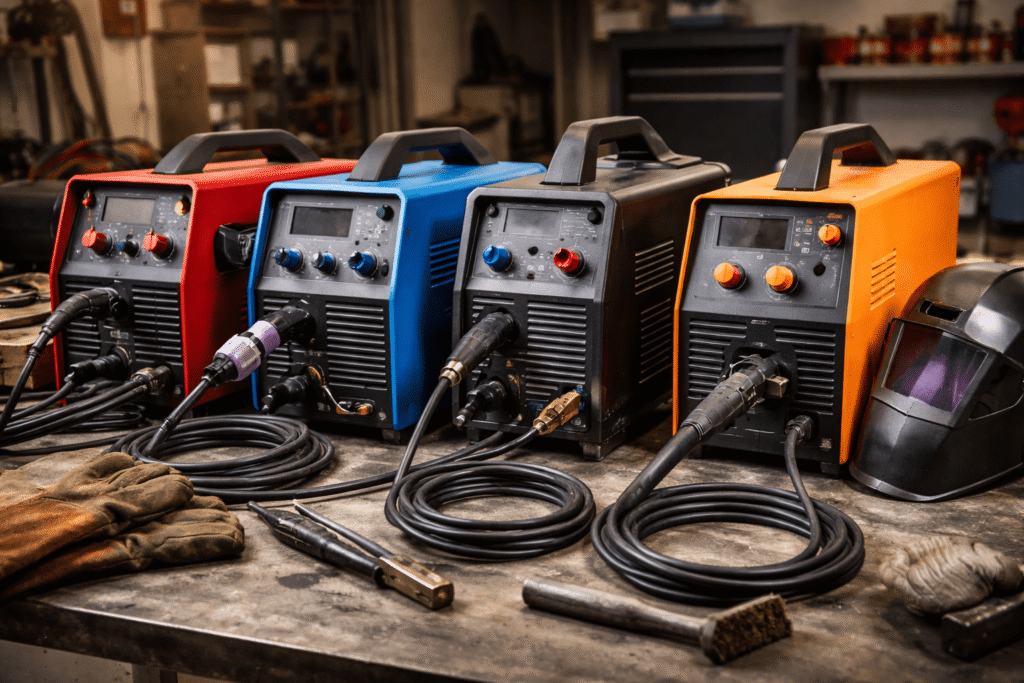
Finding the best multi process welder can save you money, space, and the hassle of switching between separate welding machines. But not every model handles MIG, TIG, and Stick welding equally well.
We’ve tested 18 multi process welders and reviewed the top 9 best multi process welders based on welding performance, ease of use, versatility, and overall value.
Best Multi Process Welders: Quick Comparison
From affordable garage welders to premium fabrication machines, these nine models stand out for different reasons. Here’s a quick comparison of their capabilities and the jobs they suit best.
| Multi Process Welder | Best For | Welding Capabilities | Input Voltage |
|---|---|---|---|
| ARCCAPTAIN MIG200 | Best Overall | MIG, Flux Core, Lift TIG, Stick, Spot | 110V/220V |
| Reboot RBM2500 PRO | Best Budget | MIG, Flux Core, Lift TIG, Stick, Spot | 120V/240V |
| Miller Multimatic 215 PRO | Best Premium | MIG, Pulsed MIG, DC TIG, Stick | 120V/240V |
| Everlast THUNDER 215 | Best for Serious DIY Fabrication | MIG, DC TIG, Stick | 120V/240V |
| ARCCAPTAIN MIG205MP | Best All-in-One Welder and Plasma Cutter | MIG, TIG, Stick, Plasma Cutting | 120V/240V |
| YESWELDER MCT-520 | Best for Beginners Who Need Plasma Cutting | MIG, TIG, Stick, Plasma Cutting | 110V/220V |
| ANDELI MIG-205DP | Best for Advanced Welding Controls | Pulsed MIG, TIG, Stick, Plasma Cutting | 110V/220V |
| SUnstac MCT-520 | Best Budget Welder and Plasma Cutter | MIG, TIG, Stick, Plasma Cutting | 110V/220V |
| PUWU MIG-160 PRO | Best Portable | MIG, Flux Core, Lift TIG, Stick | 110V/220V |
9 Best Multi Process Welders in 2026: Our Top Picks
- Best Overall: ARCCAPTAIN MIG200
- Best Budget: Reboot RBM2500 PRO
- Best Premium: Miller Multimatic 215 PRO
- Best for Serious DIY Fabrication: Everlast THUNDER 215
- Best All-in-One Welder and Plasma Cutter: ARCCAPTAIN MIG205MP
- Best for Beginners Who Need Plasma Cutting: YESWELDER MCT-520
- Best for Advanced Welding Controls: ANDELI MIG-205DP
- Best Budget Welder and Plasma Cutter: SUnstac MCT-520
- Best Portable: PUWU MIG-160 PRO
1. Best Overall: ARCCAPTAIN MIG200
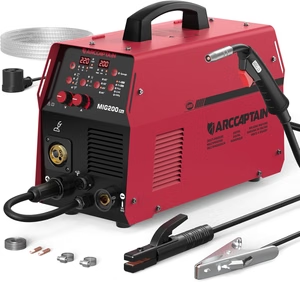
Key Specifications:
- Welding processes: Gas MIG, Flux Core MIG, Lift TIG, Stick, Spot
- Input voltage: 110V/220V
- Maximum MIG output: 200A on 220V
- Duty cycle: 60% rated
- Controls: Synergic and manual MIG settings
The ARCCAPTAIN MIG200 earned our top spot because it offers a practical balance of welding flexibility, easy controls, and price. During testing, we found the synergic MIG settings particularly useful when switching between different wire sizes. The machine automatically adjusts the recommended current and wire-feed speed, which takes some guesswork out of setup.
For everyday garage projects, the combination of gas MIG and flux-core welding is especially useful. You can work on steel brackets, small frames, or outdoor repairs without needing separate machines. I also appreciate having manual controls available when the automatic settings need a little fine-tuning.
The biggest limitation is that full 200A output requires 220V power. You’ll also need separate accessories for Lift TIG and spool gun welding. Still, for around $300, this is a welder I’d comfortably recommend to beginners and experienced DIYers alike.
Pros:
- Synergic settings simplify wire-feed and current adjustments.
- Supports several welding processes for different projects.
- Dual-voltage operation works with different workshop setups.
- Manual controls allow more precise welding adjustments.
Cons:
- Full 200A MIG output requires 220V power.
- TIG torch and spool gun aren’t included.
2. Best Budget: Reboot RBM2500 PRO
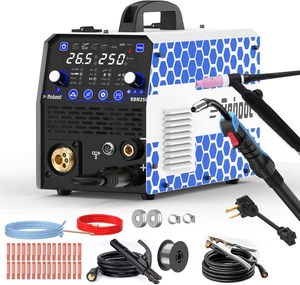
Key Specifications:
- Welding processes: MIG, Flux Core, Lift TIG, Stick, Spot
- Input voltage: 120V/240V
- Maximum advertised output: 250A
- Wire compatibility: 0.023–0.040-inch solid wire
- Included accessories: MIG torch, Lift TIG torch, multiple drive rollers
Finding a multiprocess welder around $200 with this many included accessories isn’t easy. What impressed us most about the Reboot RBM2500 PRO was how much flexibility it offers without requiring a long list of additional purchases.
When we worked through the different welding settings, the synergic MIG control made the initial setup more approachable. The included TIG torch is another advantage, especially if you’re planning to learn TIG after getting comfortable with MIG. We also liked the multiple drive rollers, which let you set up the machine for different wire types.
One thing I’d watch is the advertised 250A maximum output. Without detailed duty-cycle information at each voltage, it’s difficult to judge how well that output translates into longer welding sessions. The spool gun also costs extra. Nevertheless, this is a sensible budget option for occasional steel repairs and hobby fabrication.
Pros:
- Includes a Lift TIG torch at an affordable price.
- Supports MIG, TIG, Stick, and spot welding.
- Multiple drive rollers accommodate different welding wires.
- Synergic and manual controls suit different skill levels.
Cons:
- Limited published duty-cycle information.
- Spool gun for aluminum MIG welding is sold separately.
3. Best Premium: Miller Multimatic 215 PRO
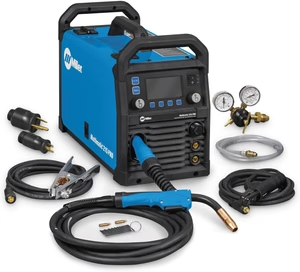
Key Specifications:
- Welding processes: MIG, Flux Core, DC TIG, Stick
- Input voltage: 120V/240V
- Rated MIG output: 215A at 30% duty cycle on 240V
- Material capacity: Up to 3/8-inch steel on 240V with MIG
- Technology: Auto-Set, Smooth-Start, BeadVision, program memory
The Miller Multimatic 215 PRO feels like a machine designed for people who spend serious time in their workshops. During our testing, the Auto-Set controls stood out because they made it easier to establish suitable starting settings without spending too much time navigating menus.
We also appreciated the Smooth-Start feature when working with MIG. Controlled arc starts are particularly useful for keeping the beginning of a weld clean. BeadVision adds another layer of feedback, while the machine’s 160A at 60% duty-cycle rating on 240V makes it a more convincing choice for longer fabrication projects.
Of course, the biggest drawback is its price. At over $2,000, it’s hard to justify for someone welding only a few times each year. It also lacks plasma cutting. But for a serious home fabricator who values welding control and established manufacturer support, the Miller deserves consideration.
Pros:
- Auto-Set reduces the time needed for initial adjustments.
- Smooth-Start helps with controlled MIG arc initiation.
- Published duty-cycle ratings support workload planning.
- Established manufacturer support and accessory availability.
Cons:
- Significantly more expensive than other options.
- Doesn’t include plasma cutting.
4. Best for Serious DIY Fabrication: Everlast THUNDER 215
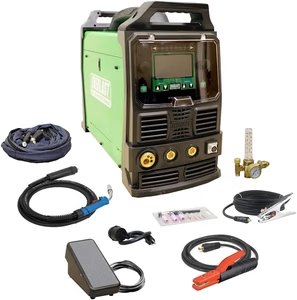
Key Specifications:
- Welding processes: MIG, Flux Core, DC TIG, Stick
- Input voltage: 120V/240V
- Maximum output: 215A MIG/TIG, 175A Stick on 240V
- Duty cycle: 35% at maximum output
- Controls: Synergic MIG, 4.3-inch display, nine memory presets
The Everlast THUNDER 215 is a good fit for DIYers who regularly switch between fabrication and repair work. When we explored its controls, the nine-setting memory was one of the most useful features. Being able to recall previous settings saves time when moving between thinner steel and heavier projects.
During our evaluation, we also liked the combination of synergic MIG and manual adjustments. The automatic settings help establish a starting point, while burn-back and arc-force controls give experienced welders more room to fine-tune their work. Its 215A MIG/TIG output on 240V is another advantage for larger garage projects.
At 57 pounds, however, this isn’t a machine you’ll want to move around constantly. Its 35% duty cycle at maximum output also means you’ll need to plan cooling breaks during demanding jobs. For a fixed workshop setup, those compromises are easier to accept.
Pros:
- Nine memory presets make repeat setups convenient.
- Strong MIG and TIG output on 240V.
- Adjustable arc force and burn-back improve control.
- Synergic and manual modes provide flexibility.
Cons:
- At 57 pounds, it’s relatively heavy to transport.
- Duty cycle at maximum output limits continuous operation.
5. Best All-in-One Welder and Plasma Cutter: ARCCAPTAIN MIG205MP
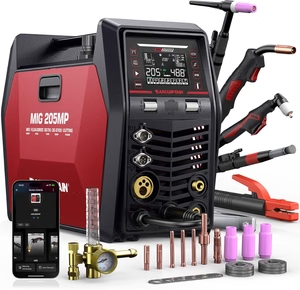
Key Specifications:
- Welding functions: Nine advertised welding and cutting modes
- Input voltage: 120V/240V
- Maximum MIG/TIG output: 205A
- Plasma cutting current: 20–40A
- Controls: Digital display, app control, saved welding profiles
The ARCCAPTAIN MIG205MP stands out because it combines welding and plasma cutting in one machine. During our testing, we found its digital interface especially interesting when switching between welding processes. Having saved profiles means you don’t need to rebuild your settings from scratch every time you change jobs.
For a garage that handles both repairs and fabrication, this combination makes sense. You can prepare steel pieces with the plasma cutter, then switch to MIG or TIG for joining them. The advanced controls also provide useful adjustments for pulse frequency, inductance, and burn-back.
The extra features do take some getting used to, though. I wouldn’t recommend starting with every advanced setting enabled if you’re still learning the basics. You’ll also need compressed air for plasma cutting, and the spool gun is separate. But for someone trying to reduce the number of machines in a workshop, it’s a strong option.
Pros:
- Combines MIG, TIG, Stick, and plasma cutting.
- Saved profiles make repeat setups easier.
- App control adds convenience for managing settings.
- Advanced adjustments support different fabrication jobs.
Cons:
- Advanced controls take time to learn.
- Requires compressed air for plasma cutting.
6. Best for Beginners Who Need Plasma Cutting: YESWELDER MCT-520
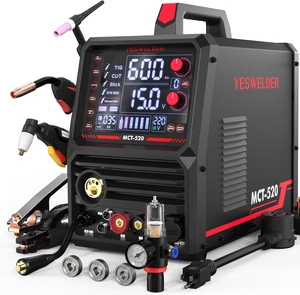
Key Specifications:
- Welding processes: MIG, Flux Core, TIG, Stick, Plasma Cutting
- Input voltage: 110V/220V
- Maximum welding output: 200A
- Duty cycle: Advertised 60% at 200A
- Display: 7-inch LED screen with automatic parameter matching
One of the first things we noticed about the YESWELDER MCT-520 was its oversized 7-inch display. It’s much easier to read than the small screens found on many compact welders, especially when you’re wearing welding gloves and trying to adjust settings between jobs.
During our evaluation, the automatic parameter matching was another feature that made sense for beginners. It provides a starting point for wire-feed speed based on your selected settings, while manual controls remain available when you need more adjustment. Having plasma cutting alongside MIG, TIG, and Stick welding also gives this machine plenty of room for different projects.
The downside is the cost. At around $700, it’s a significant investment for someone just learning to weld. A foot pedal and spool gun also require separate purchases. I’d recommend it to beginners who already know they’ll need plasma cutting, rather than someone looking for a simple first MIG welder.
Pros:
- Large 7-inch display improves control visibility.
- Automatic settings simplify initial MIG setup.
- Includes plasma cutting alongside several welding processes.
- Manual controls support more advanced adjustments.
Cons:
- Expensive compared with basic beginner welders.
- Foot pedal and spool gun cost extra.
7. Best for Advanced Welding Controls: ANDELI MIG-205DP
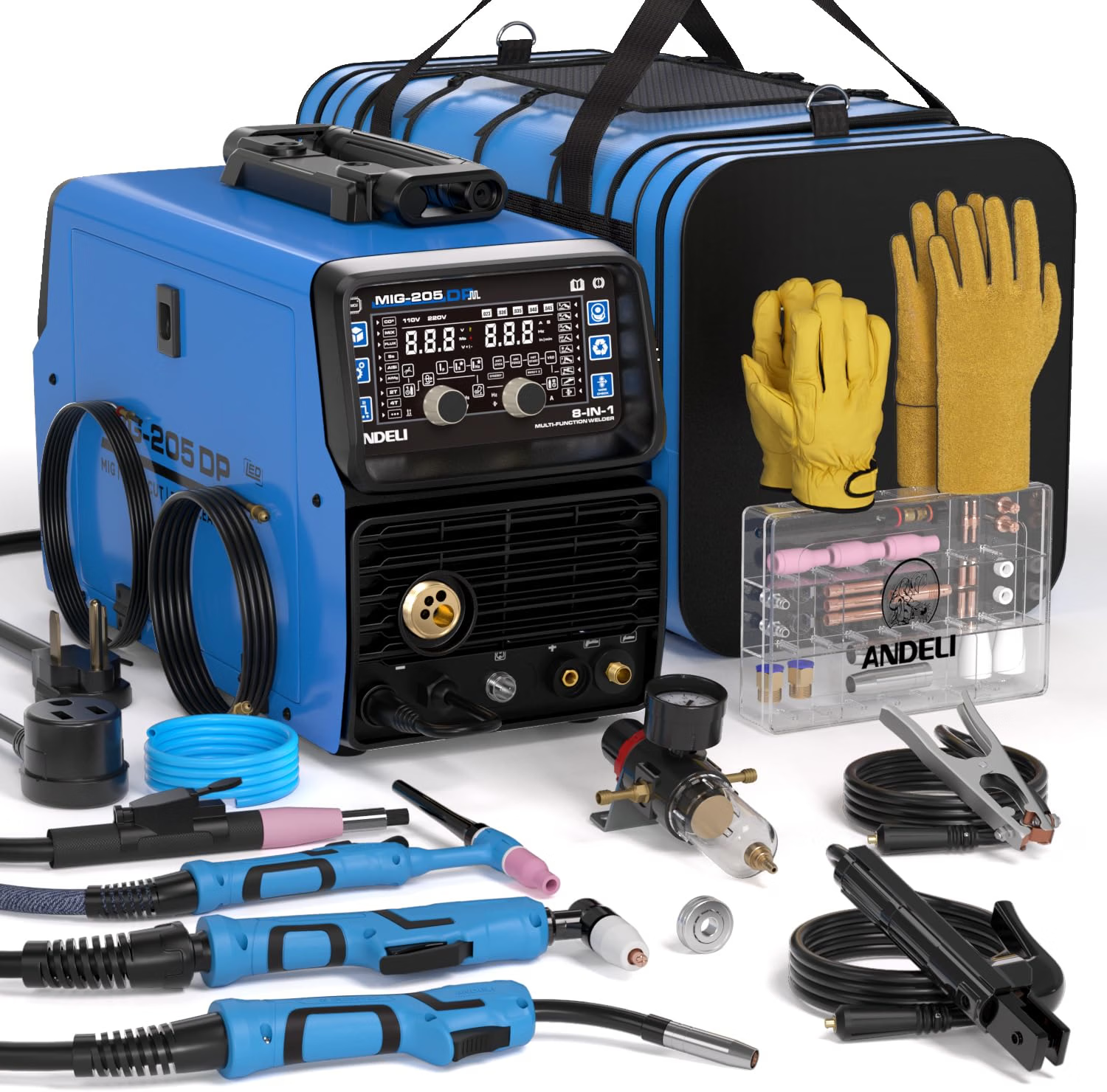
Key Specifications:
- Welding functions: Eight advertised welding and cutting modes
- Input voltage: 110V/220V with auto-detection
- MIG output: 30–205A
- Plasma cutting current: 20–40A
- Controls: Pulsed MIG, HF TIG, inductance, pulse settings, 2T/4T
The ANDELI MIG-205DP is one I’d consider if you enjoy adjusting welding parameters to suit different materials. During testing, we spent time exploring its pulsed MIG and manual control options. The ability to adjust wire feeding, inductance, and pulse settings gives you more control than a basic synergic welder.
What stood out most was the range of available processes. Its HF TIG start is useful for initiating the arc without touching the tungsten to the workpiece, while pulsed MIG offers additional ways to manage heat input on thinner metal. The integrated plasma cutter also makes it convenient for preparing material before welding.
Still, this isn’t the easiest machine for someone who’s never welded before. The interface has plenty of settings to learn, and plasma cutting requires a separate air supply. For intermediate hobbyists who want to experiment with different welding techniques, though, it offers useful flexibility.
Pros:
- Pulsed MIG provides additional heat-control adjustments.
- HF TIG supports non-contact arc starting.
- Wide range of manual controls for experienced users.
- Includes plasma cutting for metal preparation.
Cons:
- Complex interface can overwhelm beginners.
- Plasma cutting requires compressed air.
8. Best Budget Welder and Plasma Cutter: SUnstac MCT-520
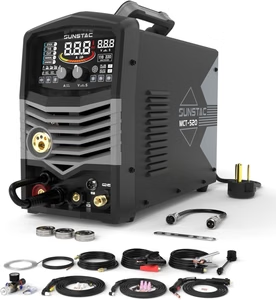
Key Specifications:
- Welding processes: MIG, Flux Core, TIG, Stick, Plasma Cutting
- Input voltage: 110V/220V
- Maximum MIG output: 200A
- Plasma cutting output: 50A
- Cutting capacity: 10 mm clean cut, 15 mm maximum advertised
For a multiprocess welder with plasma cutting, the SUnstac MCT-520 comes in at a surprisingly accessible price. During our evaluation, the combination of synergic MIG settings and a 50A plasma cutter made it stand out from basic multiprocess machines in the same price range.
I particularly like the idea of using one machine to cut and join metal for small fabrication projects. If you’re building brackets, repairing equipment, or preparing steel plates, having both functions available saves workshop space. The automatic MIG adjustments also make setup less intimidating for beginners.
The cutting function does require a suitable compressor delivering around 4.2 CFM at 50–60 PSI. That’s an important extra expense if you don’t already own one. Also, its 15 mm maximum cutting capacity shouldn’t be confused with its cleaner 10 mm cutting rating. For a budget workshop, though, the overall combination is appealing.
Pros:
- Includes a 50A plasma cutter at an affordable price.
- Supports multiple welding methods.
- Synergic MIG control helps with initial settings.
- Dual-voltage input offers setup flexibility.
Cons:
- Requires an air compressor for plasma cutting.
- Maximum cutting thickness is greater than clean cutting capacity.
9. Best Portable: PUWU MIG-160 PRO
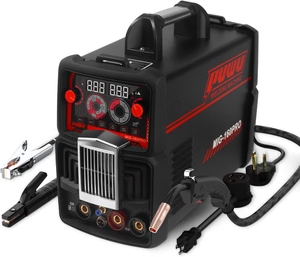
Key Specifications:
- Welding processes: Gas MIG, Flux Core, Lift TIG, Stick
- Input voltage: 110V/220V
- Maximum output: 160A
- Weight: 15.3 pounds
- Controls: Synergic and manual MIG settings
The PUWU MIG-160 PRO is designed for people who need to move their welding equipment around rather than keep it on a permanent bench. During our hands-on evaluation, its 15.3-pound weight was one of the first things we appreciated. The carrying handle and shoulder strap make transporting it much more convenient.
Despite the compact design, it supports both gas MIG and flux-core welding. That’s useful if you’re handling cleaner indoor welds one day and outdoor steel repairs the next. We also liked having synergic settings for quick setup, with manual adjustments available when the job needs more control.
The trade-off is its lower 160A-class output. It’s better suited to small repairs and light fabrication than sustained heavy-duty welding, particularly on 110V power. The Lift TIG torch isn’t included either. Still, if portability matters more than maximum output, this is a practical little multiprocess machine.
Pros:
- Lightweight 15.3-pound construction is easy to carry.
- Shoulder strap makes transportation more convenient.
- Supports gas MIG and flux-core welding.
- Includes synergic and manual MIG controls.
Cons:
- Limited output for heavier fabrication work.
- Lift TIG torch requires a separate purchase.
How to Choose the Best Multi Process Welder
Not all multi process welders deliver the same performance, even with similar features. Here are the key factors I’d consider before choosing one for your workshop.
Choose the Welding Processes You Need
MIG welding is great for beginners, steel repairs, and general fabrication. Flux-core works well outdoors without a shielding gas cylinder, while TIG offers better heat control for precise work.
Stick welding suits heavier steel and outdoor repairs. If you also cut metal regularly, consider a machine with a plasma cutter. Focus on the processes you’ll use rather than the number of advertised modes.
Check Input Voltage
Most dual-voltage welders support 120V and 240V, but their output varies.
For example, the ARCCAPTAIN MIG200 delivers up to 200A on 220V versus 160A on 110V. Higher voltage gives you more flexibility for thicker steel. Just make sure your garage circuit can handle the machine’s electrical requirements.
Compare Amperage and Duty Cycle
Amperage determines available welding current, while duty cycle tells you how long the machine can weld before needing to cool down.
A 60% duty cycle means six minutes of welding within a ten-minute period at the specified current. For longer fabrication jobs, compare duty-cycle ratings at similar amperages instead of focusing only on maximum output.
Look for Easy-to-Use Controls
Synergic controls automatically suggest welding settings based on wire size and other selected parameters, making setup easier for beginners.
Manual controls give you more flexibility to adjust the arc for different materials and joints. I’d choose a machine with both, so you can start simple and fine-tune settings as your skills improve.
Consider Accessories and Additional Costs
Not every welder includes the accessories needed for all its welding modes. You may need a TIG torch, shielding gas, spool gun, or additional consumables.
Plasma cutting also requires compressed air. Check what’s included before buying, since a cheaper machine can cost more once you add the necessary equipment.
Think About Portability and Workshop Space
If you move between jobs, weight and size matter. The 15.3-pound PUWU MIG-160 PRO is easier to carry than the 57-pound Everlast THUNDER 215.
Larger machines may offer more power and controls, but compact welders are more convenient for smaller garages and occasional repairs. Choose based on your workspace and the projects you handle.
What Most Buyers Overlook When Setting Up a Multi Process Welder
A multi process welder may support several welding modes, but not every function works straight out of the box. Here are three things I’d check before buying.
- First, consider the total setup cost. You may need a separate TIG torch, shielding gas cylinder, or spool gun. Plasma cutting also requires an air compressor, which adds to the overall cost.
- Next, check your garage’s electrical setup. A 120V welder won’t necessarily deliver its maximum output through a standard household outlet. For thicker steel and longer jobs, a suitable 240V circuit can make a difference.
- Finally, don’t overlook safety. Welding sparks can ignite nearby materials. According to OSHA’s welding safety standards, combustible materials should be moved at least 35 feet away when practical or properly shielded.
I’d recommend planning your complete setup before buying. The right accessories, electrical supply, and safety equipment matter just as much as the welder itself.
Final Words
The best multi process welder should offer the right balance of welding power, easy controls, and versatility for your projects.
For most DIYers, the ARCCAPTAIN MIG200 is my top pick. It combines MIG, TIG, and Stick capabilities with beginner-friendly settings and useful manual controls.
If you’re on a tighter budget, the Reboot RBM2500 PRO is a solid alternative. It supports multiple welding processes and includes a TIG torch at an affordable price.
Ultimately, choose a welder that fits your projects, budget, and available power supply.
Frequently Asked Questions
Is a multi process welder worth buying?
Yes, especially if you regularly use two or more welding processes. A multiprocess machine saves workshop space and can cost less than buying separate MIG, TIG, and Stick welders. For someone who only needs basic MIG welding, a dedicated MIG welder may be more economical.
Can a multi process welder weld aluminum?
Some multiprocess welders support aluminum MIG welding using a compatible spool gun or suitable wire-feed setup. Aluminum TIG welding generally requires AC TIG capability for conventional aluminum work, so check the machine’s specifications before buying.
Is MIG or TIG better for beginners?
MIG is easier for most beginners because the wire feeds automatically, making it simpler to maintain a steady weld. TIG requires more coordination and precise heat control. I’d recommend starting with MIG for basic steel fabrication and repairs.
Can I use a multi process welder on a household outlet?
Some multiprocess welders operate on 120V household power, but they may deliver less output than on 240V. Always check the required circuit amperage, breaker, and electrical connections before use.
What is the difference between a MIG welder and a multi process welder?
A dedicated MIG welder focuses on wire-feed welding. A multiprocess welder combines MIG with other processes such as TIG and Stick. Some models also include plasma cutting, making them more versatile for different metalworking projects.

Mark Reynolds is the founder and senior editor of ToolCruiser, with over fifteen years of hands on experience working in real home garage workshops. His background includes home repairs, woodworking, garage builds, and small scale metal fabrication. Mark oversees all core content and product testing, focusing on real world performance, safety, power requirements, and long term value for homeowners using standard tools and setups.